

THE FAST LUXURY PHENOMENON: AN ANALYSIS OF THE MICHAEL KORS CASE AND REPOSITIONING STRATEGIES

Author: Anna Mietta
Date: 18-09-2026
The contemporary luxury market has undergone a profound transformation in recent years linked to the emergence of the Fast Luxury sector, an intermediate dimension based on a compromise between accelerated production cycles and aspirational prestige. However, adopting logic typical of the mass market triggers dangerous brand dilution processes that erode brand exclusivity and compromise brand equity.
This research investigates these dynamics in the Italian market through the Michael Kors case study, with the core objective of formulating a strategic upward repositioning plan capable of remedying the effects of decline, rehabilitating the brand in an exclusive key, and engaging Gen Z. Through the combined use of four advanced statistical techniques (Conjoint Analysis, Cluster Analysis, Multidimensional Scaling and Correspondence Analysis), the study maps consumers’ perceptual space to redefine the Marketing Mix levers and reconnect the brand with high-value segments.
THE MARKET
According to the Business of Fashion & McKinsey & Company report (2025), the luxury fashion market in Italy is estimated to reach a value of approximately 20 billion euros by the end of 2026; however, 80% of this growth is driven by price increases rather than sales volumes, generating widespread Luxury Fatigue among the middle class and positioning Fast Luxury as the gateway channel with the highest potential due to its five main characteristics:
- Economic accessibility (Kumar et al., 2020);
- Reduction of time-to-market (Tokatli, 2008);
- High frequency of replenishment (Caro & Gallien, 2010);
- Hyper-intensive distribution (Castaldo, 2008);
- Supply chain flexibility (Christopher, 2008).
The adoption of this business model by a growing number of companies has turned it into a full-fledged, constantly expanding market sector. Today, it features numerous iconic brands such as Michael Kors, Coach, Longchamp, Furla, and Pinko. Among these, a standard strategy is observed, based on a three-pronged distribution approach (flagship stores, department stores and outlets) and price positioning in the range between 200 and 600 Euros.
Against these common foundations, the main elements of competitive differentiation lie in sustainability and digital communication. Brands like Coach and Longchamp transform sustainability into a strategic pillar and leverage organic user-generated content (UGC) to engage Gen Z, while other brands adopt more conservative or traditional approaches. Ultimately, survival in the Italian market does not depend solely on controlling the price range, but on the ability to convert these levers into unique, distinctive competitive advantages rather than simple responses to moment-driven trends.
METHODOLOGY
To answer the research questions, the study adopted a mixed methodological approach, combining a preliminary qualitative phase with a subsequent quantitative investigation. The statistical core of the thesis involved the sequential application of four multivariate statistical techniques:
- Conjoint Analysis: An analytical technique that allows to deterine at an individual level, starting from a global evaluation of the product and through linear regression, the perceived value of each attribute composing the product (Rao, 2010);
- Cluster Analysis: Used to divide a set of objects into subsets called “clusters” so that elements belonging to the same group are maximally similar to each other (intra-cluster homogeneity) and maximally distant from elements in other groups (inter-cluster heterogeneity) (Hair et al., 2018);
- Correspondence Analysis: An exploratory “attribute-based” perceptual mapping technique, widely used for its ability to summarize large contingency tables (Gower et al., 2010);
- Multidimensional Scaling: A “non-attribute-based” approach that explores the global perception of similarity or difference between brands, allowing latent dimensions and implicit criteria guiding target judgments to emerge (Hair et al., 2014).
Operationally, Conjoint Analysis was used to decompose the purchasing process and estimate the part-worth utilities assigned by consumers to individual offer attributes. The individual utility values obtained was used as the input for Cluster Analysis, enabling the aggregation of respondents into clusters based on perceived value. Finally, the two Perceptual Mapping techniques made it possible to project the consumers’ perceptual space and highlight competitive distances between brands; integrating directional targets within these maps provided the empirical foundations for defining the repositioning strategy.
QUANTITATIVE ANALYSIS
Sample Description
Data was collected via a CAWI (Computer Assisted Web Interviewing) questionnaire administered to a sample recruited through the snowballing technique, initially consisting of 212 consumers and subsequently reduced to 174 observations following dataset cleaning.
Demographically, the sample consists mainly of younger population segments, although it includes older individuals (Chart 1), and almost exclusively represents the female population (98,3%).
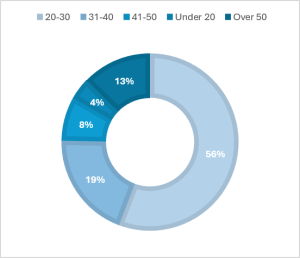
Chart 1. Demographic distribution of the sample
The analysis of touchpoints guiding consumer decision-making shows a clear prevalence of digital channels, both in terms of official social profiles (74.1%) and Influencer Marketing (66.7%), followed by promotions (55.2%), and lastly by traditional channels such as word-of-mouth (43.7%), newsletters (15.5%), and TV commercials (6.3%).
Preference Analysis
Applying Conjoint Analysis required setting up a preliminary orthogonal design resulting from the combination of three attributes (Price, Size, and Color) and their respective levels (Table 1).
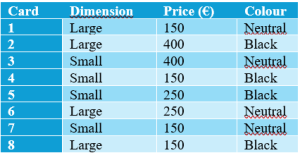
Table 1. Orthogonal design generated for the Conjoint Analysis application, containing eight cards with descriptions of attributes and levels
The Utility Estimate Table (Table 2) reveals that the Price attribute almost exclusively drives the decision-making process at an aggregate level, displaying an inverse proportional relationship with utility. The Size and Color attributes show significantly different weights: size accounts for approximately 15% of the purchasing process, with a clear preference for small models, while color plays a marginal role at 0,6%. Segmenting the population by age group reveals a crucial insight: for younger consumers, price is a categorically discriminating attribute, an importance that progressively decreases in adult groups until reaching a radical reversal in senior profiles, where color becomes the top priority.
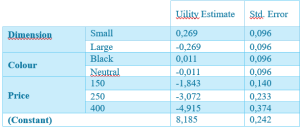
Table 2. Utility Estimate Table
Consumer Segmentation
Starting from the individual part-worth utility coefficients, four distinct segments were identified and named based on their specific preferences (Table 3):
- Price-Sensitive Rationals (N=39): Characterized by high price sensitivity and little interest in small sizes, they prefer the Outlet channel (66,7%) and are the main users of online multi-brand platforms (53,8%). This cluster consists of 71,8% Under-30s and includes no Over-50 profiles;
- Small Lovers (N=29): Composed of 24% Over-50s, they are strongly driven by mini bags. In 73% of cases, they purchase at single-brand Boutiques, seeking the experience and customer service that add value to the customer journey;
- Dark Aesthetics (N=36): Selectively guided by the black color variant, they show balanced purchasing behavior, oscillating between Boutiques (52,8%) and Outlets (44,4%). This cluster is the second “Oldest” after Small Lovers (22,2%);
- Neutral Seekers (N=70): A balanced segment with a distinctive preference for neutral tones. In addition to preferring Boutiques as their main purchase channel (72,9%), they visit Department Stores more than any other group (54,3%). They show a more balanced demographic distribution compared to the first cluster, while still maintaining a youth majority (61,4%).
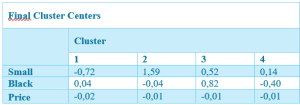
Table 3. Final Cluster Centers
These segments were subsequently profiled through bivariate analyses, which overall showed a cross-cutting influence of digital channels and an interest in ESG topics.
BRAND POSITIONING AND PERCEPTION
Brand Equity Analysis
The overall direct rating of Michael Kors stands at an average of 5,069 (on a 1 to 9 Likert scale), suggesting a perception of slight insufficiency in the consumers’ mind. Looking at individual attributes (Chart 2), the average drops to 4.213, indicating a perception below the passing threshold. The only adjectives receiving a passing score (>5.4) are “Popular” and “Affordable”. The worst scores are found in Sustainability (3,33), Innovation (3,36), and Exclusivity (3,49).
These data highlight how the market struggles to associate Michael Kors with distinctive luxury traits, relegating it to a more democratic, commercial space far removed from the values consumers seek.
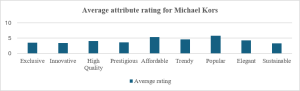
Average rating of Michael Kors across nine attributes evaluated on a 1 (“terrible”) to 9 (“excellent”) Likert scale
Perceptual Mapping
The next step mapped the competitive status quo using Correspondence Analysis, positioning brands and 14 qualifying attributes in a two-dimensional model (Figure 1) explaining 83,7% of total inertia. Along the “Classic-Trendy” and “Mass Market-Premium” axes, Coach and Longchamp firmly occupy the Premium-Trendy quadrant, associated with trendiness and sustainability. Conversely, Michael Kors is the only player registering negative scores on both axes, projecting into the mass-market/classic quadrant in close proximity to the vectors for “Accessible”, “Poor Quality” and “Flashy”.
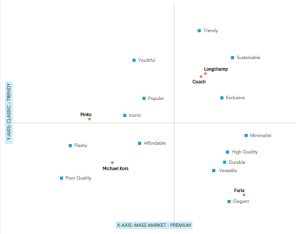
Figure 1. Positioning map obtained via Correspondence Analysis, constructed as a scatter plot of brands and associated attributes
To validate this evidence and exclude forced associations with specific attributes, Multidimensional Scaling was applied starting from global similarity judgments. The scenario (Figure 2) reveals high concentration and psychological interchangeability among almost all brands, with only Longchamp standing apart, while Michael Kors converges toward “Poor Quality” and “Flashy”. Its clear distance from the “Sustainability” vector confirms its complete isolation from the ethical values demanded by Gen Z.
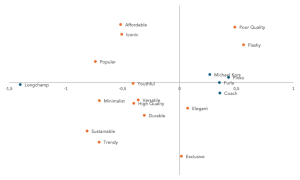
Figure 2. Positioning map obtained via Multidimensional Scaling, constructed as a scatter plot considering distances between brands and explanatory attributes
STRATEGY AND MANAGERIAL IMPLICATIONS
Based on the findings and selected targets, a two-phase repositioning strategy was formulated (Figure 3). The first short-term phase aims to move away from the critical quadrant toward the coordinates of Elegance, targeting Neutral Seekers. The second long-term phase focuses on an upward shift to capture Exclusivity and attract Dark Aesthetics, while maintaining stable volume from Price-Sensitive Rationals throughout the strategy.
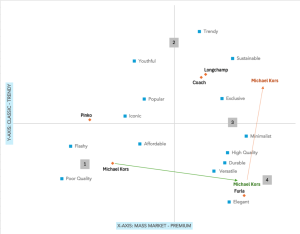
Figure 3. Repositioning trajectories for Michael Kors through Phase 1 (green) and Phase 2 (orange) on the Correspondence Analysis map, including cluster locations (in gray)
Regarding the Marketing Mix, the move is completed by reorganizing the brand’s product portfolio through a dual offer separation designed to isolate different targets with dedicated value propositions:
- Kors Heritage: Aimed at the full-price channel, it features small models in initially neutral and later dark tones to capture the preferences of the two target groups (Neutral Seekers and Dark Aesthetics). Leveraging their high spending power, an initial price positioning between 250 and 270 euros is planned, later increasing to 300 euros while eliminating promotional discounts. Core products will be complemented by extra services such as bag customization in a dedicated Atelier Corner and free sustainable packaging. Promotionally, social media communication, following the creation of official Italian profiles, will focus on minimal, value-driven storytelling and targeted Influencer Marketing.
- MK Essentials: Aimed at the outlet channel to capture the solid base of Price-Sensitive Rationals, it will center on spacious, dark models priced between 100 and 130 euros, with maximum discounts capped at 20%. Promotional campaigns here must highlight the tangible features of the product.
Additionally, an upcycling system is planned for both lines to sustainably manage unsold inventory and reinforce green commitments.
Regarding distribution (Place), the strategy involves delisting from indirect digital platforms like Zalando to disincentivize transactional purchases. Consequently, Michael Kors’s official e-commerce site will remain the sole virtual channel offering the brand’s bags, as it is uniquely capable of communicating the new brand values consistently with the repositioning strategy.
CONCLUSIONS
The causes of the brand’s decline were isolated to uncontrolled volume growth and severe brand dilution. Combined perceptual mapping techniques visually demonstrated the current perception: a brand associated with flashiness and low quality, disconnected from Gen Z’s demand for sustainability macro-trends.
The evidence shows that recovering exclusivity does not require turning away value-driven customers, but rather strictly segregating them commercially to the outlet channel. This allows the boutique channel to move upmarket without compromising the holding company’s global economic stability. This outcome is achieved by establishing two value propositions reflecting the distinct marketing mix structures highlighted earlier.
Rationalizing commercial channels, segregating demand, and renewing the stylistic identity with an ethical, minimal focus are not merely viable options, but they represent the only sustainable managerial direction to break free from fast fashion volume logic and restore the authority, exclusivity, and prestige needed for Michael Kors to re-establish itself as a desirable, competitive, and profitable brand in the international fashion landscape.



 LinkedIn:
 Instagram: