

M&A performance and behavior: A comparative event study of European and US publicly listed family firms

Author: Konstantinos Markou
Date: 30-10-2026
Mergers and acquisitions represent some of the most consequential decisions a company can make. They can provide access to new markets, reshape competitive dynamics, and accelerate growth. Nevertheless, their performance remains uncertain. While some transactions create substantial shareholder value, others fail to deliver on their potential.
Family firms add another dimension to this question. Compared with widely held companies, they are characterized by long-term orientation, reputational concerns, and a desire to preserve family control across generations. Their concentrated ownership may improve monitoring and align the interests of managers and shareholders. At the same time, family firms may act more cautiously or accept greater risks when family control is at stake. However, family firms do not operate within a homogeneous institutional environment.
The United States is generally characterized by stronger investor protection and more fragmented ownership. Europe, by contrast, is more heterogeneous in its legal and governance frameworks, while ownership tends to be more concentrated and family firms are more prevalent.These differences raise the central research question: To what extent do M&A performance and behavior differ between European and US publicly listed family firms?
Research design
The analysis separates M&A behavior from short-term M&A performance. The first part compares five characteristics of acquisition behavior: deal size, percentage of shares acquired, cross-border activity, deal frequency, and diversification. The second part examines whether the stock market reacts differently to M&A announcements made by European and US publicly listed family firms.
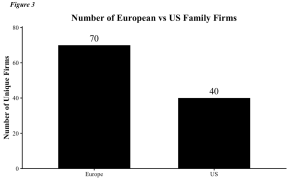
The sample consists of 70 European and 40 US publicly listed family firms.
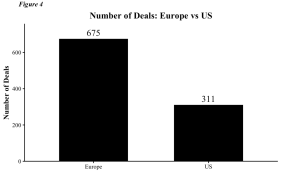
Between 1 January 2000 and 31 December 2024, European family firms completed 675 acquisitions, while US family firms completed 311.
Data and methodology
The starting point was the “EY and University of St. Gallen Global 500 Family Business Index”, which lists the 500 largest family firms worldwide. From this dataset, the currently listed European and US family firms were selected. M&A transactions were obtained from the Deals universe in Refinitiv Workspace. Refinitiv was also used to collect the daily market prices and stock returns required for the event study. The initial screening produced 2,352 M&A events. The dataset was subsequently refined by removing observations with missing essential information, such as deal value or announcement date. Potential duplicate transactions and deals without sufficient market or financial data were also excluded. The final sample used in the main empirical analysis consisted of 986 completed M&A transactions. Since deal value, ownership percentage, and deal frequency were affected by skewness and outliers, the study used medians and Wilcoxon rank-sum tests. A bootstrap confidence interval was also applied to the difference in median deal value. Cross-border activity and diversification were examined using two-sample tests for equality of proportions.
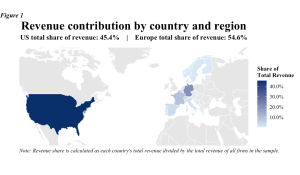
Measuring short-term M&A performance
Short-term performance was assessed using an event-study methodology. Normal stock returns were estimated during a period beginning 250 days before the announcement and ending 30 days before it. The normal returns were estimated using the constant mean return model. Actual returns were then compared with normal returns to calculate abnormal returns, which represent the additional gains or losses associated with the M&A announcement. The abnormal returns within each event window were aggregated to calculate cumulative abnormal returns, or CAR. Positive CAR indicates shareholder value creation, while negative CAR represents a loss.
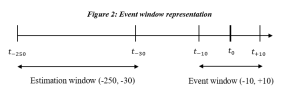
Three different event windows were examined:
- One day before to one day after the announcement: (-1, +1)
- Three days before to three days after the announcement: (-3, +3)
- Ten days before to ten days after the announcement: (-10, +10)
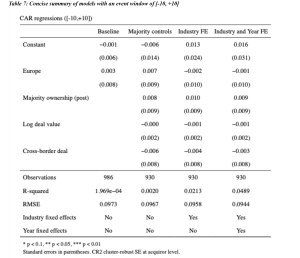
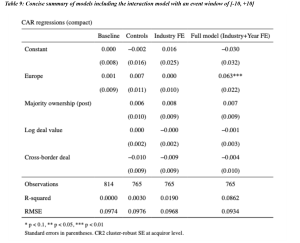
Four cross-sectional regression models were estimated: a baseline model, a model controlling for majority ownership, deal value, and cross-border status, a model with industry fixed effects, and a full model including both industry and year fixed effects. The analysis was also repeated for periods before and after the financial crisis and extended through an industry interaction model.
US family firms undertake larger deals
The first significant behavioral difference concerns deal size. The median value of acquisitions completed by US family firms was €201.91 million, compared with €106.80 million for European family firms.
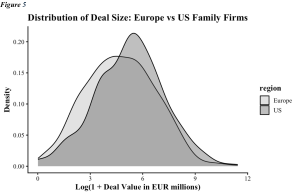
The distribution of US deals is positioned to the right of the European distribution, indicating that US family firms generally undertake larger transactions. The Wilcoxon test produces a p-value of 0.000128, meaning that the difference is highly statistically significant. The bootstrap analysis also supports this result, as the estimated difference in median deal value is €95.11 million, with a 95% confidence interval between €49.79 million and €153.75 million. The evidence therefore shows that US family firms undertake significantly larger M&A transactions than European family firms.
US family firms acquire larger ownership stakes
The second difference concerns the percentage of the target company acquired. The median percentage of shares acquired by US family firms was 100%, compared with 65% for European family firms.
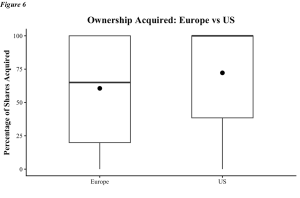
The graph shows that a large proportion of US acquisitions are full takeovers. European family firms, by contrast, appear more likely to acquire partial ownership positions. The Wilcoxon-test p-value is 0.00000827, confirming that the difference is statistically significant. US family firms therefore follow a more control-oriented acquisition approach, while European firms tend to acquire lower ownership stakes.
European family firms undertake more cross-border acquisitions
A particularly significant difference emerges in international acquisition activity. Approximately 71% of the acquisitions completed by European family firms were cross-border transactions, compared with 32% for US family firms.
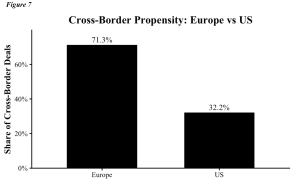
The difference is statistically significant, with a two-sample proportion-test p-value of approximately . Europe consists of numerous relatively small neighboring economies. European family firms may therefore need to expand beyond their domestic markets to identify additional growth opportunities. US family firms, by contrast, operate within a substantially larger domestic economy, making international acquisitions less essential for growth.
Deal frequency and diversification
European family firms completed a median of seven deals per company, compared with six deals among US family firms.
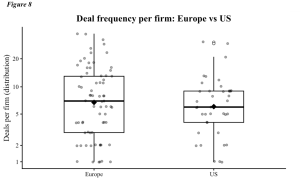
Although the graph indicates a slightly higher median for European companies, the Wilcoxon-test p-value is 0.519. The difference is therefore not statistically significant. Neither group can be described as systematically more acquisitive than the other.
Diversification was measured according to whether the acquiring company and the target operated within the same macro-industry. Approximately 69.63% of European acquisitions involved companies from the same industry, compared with 73.63% of US acquisitions.
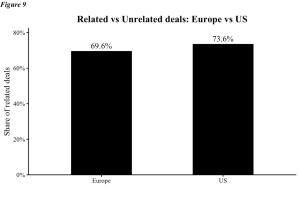
US family firms appear to diversify slightly less than European firms. However, the proportion-test p-value is 0.226, meaning that the difference is not statistically significant. The main distinction between the two groups therefore concerns the structure and type of their transactions rather than their overall willingness to undertake acquisitions or diversify into other industries.
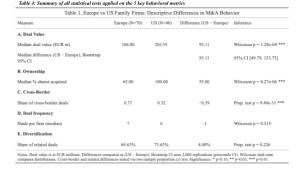
Overall, US family firms are characterized by larger, more ownership-concentrated, and more domestic acquisitions. European family firms are characterized by smaller, less control-intensive, and more internationally oriented transactions. These findings are descriptive rather than causal. They demonstrate that the two groups behave differently, but they do not establish why these differences arise.
Different behavior, similar short-term performance
Despite the clear differences in M&A behavior, the event-study results do not identify a systematic difference in short-term M&A performance. Across the four main regression models, the coefficient associated with European acquiring firms remains small and statistically insignificant. This result continues after introducing deal-level controls, industry fixed effects, and year fixed effects. The conclusion is also consistent across all three event windows. Therefore, the null hypothesis that European and US publicly listed family firms do not differ in short-term M&A performance cannot be rejected. The market appears to assign similar levels of short-term value creation to acquisitions announced by the two groups, even though the structure of their transactions differs substantially.
Did the financial crisis change the results?
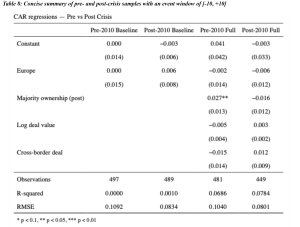
To examine whether the results changed over time, the sample was divided into a pre-financial-crisis period and a post-financial-crisis period. The Europe coefficient remained statistically insignificant in both periods. The financial crisis therefore did not appear to change the relative short-term M&A performance of European and US family firms. The majority-ownership coefficient was positive and statistically significant during the pre-crisis period, suggesting that acquiring majority control was associated with positive short-term performance during that period. However, this effect became negative and statistically insignificant after the crisis. Deal size and cross-border status did not produce consistent or statistically significant results across the two periods.
Does performance differ across industries?
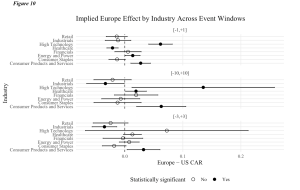
The industry interaction analysis produces some evidence of sector-specific differences. Within the reference industry, “Consumer products and services”, European acquiring family firms earned approximately 6.3 percentage points higher CAR than US family firms operating in the same sector. The result was statistically significant at the 1% level. Consumer products and services was the only sector in which the performance difference remained statistically significant across all three event windows. The results also suggest that US family firms outperformed European firms in Industrials, while European firms outperformed US firms in High Technology. However, these differences were not significant across every event window. Several confidence intervals are relatively wide because some industries contain comparatively few M&A transactions. Statistical significance also depends on the sector and event window selected. The industry findings should therefore be interpreted cautiously. They indicate possible sector-level heterogeneity but are not sufficiently consistent to overturn the study’s main conclusion.
Conclusion
European and US publicly listed family firms behave differently when undertaking mergers and acquisitions. Their transactions differ significantly in deal size, percentage of ownership acquired, and cross-border activity. Nevertheless, these behavioral differences do not translate into systematic differences in short-term M&A performance. Neither group consistently outperforms the other around the announcement date. The findings therefore suggest that different acquisition strategies can lead to comparable short-term shareholder-value outcomes.
One possible explanation discussed in the study is that characteristics shared by family firms, including long-term orientation, concentrated ownership, and a disciplined investment approach, may be more important for short-term M&A performance than regional differences. However, this remains a possible interpretation rather than a definitive causal conclusion. The analysis also has limitations. The regression models have relatively low explanatory power, and the industry analysis includes wide confidence intervals in sectors with fewer observations. Moreover, the event study uses only the constant mean return model to estimate normal returns. Finally, the study focuses exclusively on short-term market reactions. It therefore does not exclude the possibility that differences between European and US family firms may emerge over a longer period.
Future research could examine long-term M&A performance using accounting measures, which may capture post-acquisition integration and the realization of synergies more effectively. It could also compare family and non-family firms to investigate whether a distinct family-firm effect exists. Overall, the institutional environment may shape the M&A behavior of publicly listed family firms, but it does not automatically translate into differences in short-term M&A performance.



 LinkedIn:
 Instagram: