

The perceived value of a PhD in the job market: what really matters to recruiters

Author: Eubien Manalo
Date: 02-10-2026
A PhD represents the highest level of formal education. Yet, its value in the job market, especially outside academia, often remains unclear.
On one hand, existing literature shows that PhD holders benefit from high employment rates and salary premiums. On the other, its recognition within companies, particularly in Italy, is still limited and PhDs are often affected by skill underutilization and international mobility trends.
So, how much does a PhD actually matter when recruiters evaluate candidates?
This research originates from an initiative promoted by a member of SIDRI (Società Italiana del Dottorato di Ricerca) and addresses this question by shifting the perspective from PhD holders to a less explored but crucial viewpoint: that of HR professionals.
Research objective
The aim of this study is to analyze the role of a PhD in recruitment processes and understand how it is evaluated compared to other key elements, such as:
- work experience
- technical skills
- soft skills
More specifically, the research addresses the following questions:
- What factors do recruiters prioritize when evaluating candidates?
- What is the actual role of a PhD in the selection process?
- Do different recruiter profiles apply different evaluation criteria?
- Are there differences between national contexts (Italy vs UK) in the way a PhD is valued?
By answering these questions, the study aims to provide a clearer and more structured understanding of how academic qualifications, particularly a PhD, fit within real-world hiring decisions.
Methodology
The study adopts a quantitative approach based on a survey conducted with 200 HR professionals from Italy and the United Kingdom, including both internal recruiters and external HR consultants.
The research specifically targets professionals actively involved in recruitment and selection processes, ensuring a consistent B2B perspective.
The data collection was carried out through a professional panel provider, PureSpectrum, which recruited respondents in line with the research targeting criteria. The panel activation was funded by Analytics Arts, a company specialized in data analytics, market research, and strategic consulting.
A total of 297 initial responses were collected. After a rigorous data cleaning process (including the removal of screen-outs, dropouts, speeders, and straightliners) the final sample consisted of 200 valid respondents, evenly distributed between:
- Italy (99 respondents)
- United Kingdom (101 respondents)
The analysis is structured across multiple stages:
- evaluation of CV attributes
- Factor analysis
- Cluster analysis
- Conjoint analysis (simulating real decision-making scenarios)
This approach allows to go beyond stated preferences and capture more realistic selection dynamics.
The core issue: the PhD is not fully recognized
A key insight emerges from the analysis, a PhD is associated with valuable competencies such as:
- analytical thinking
- problem-solving
- project management
However, it is also perceived as:
- overly theoretical
- not fully aligned with business needs
- sometimes leading to overqualification concerns
The issue, therefore, is not just the degree itself, but how its value is communicated and interpreted.
In particular, the presence of company policies explicitly recognizing PhD profiles plays a significant role in shaping perceptions.
When organizations adopt structured policies for integrating PhD holders, the overall evaluation of the degree is significantly higher compared to contexts where no clear policies are in place.
This suggests that the perceived value of a PhD is not only an individual attribute, but also an organizational construct, shaped by internal practices, awareness, and strategic alignment.
What really drives candidate selection?
The findings are clear: recruiters prioritize operational drivers over academic ones.
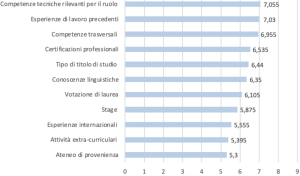
Figure 1: Average of the importance scores for the elements of the resume
The most important factors in candidate evaluation are:
- Work experience
- Technical skills
- Soft skills
Academic credentials, including a PhD, rank lower in importance.
This does not mean that a PhD has no value, but rather that it is not sufficient on its own to drive selection decisions.
There is no “One Type” of recruiter
One of the most interesting contributions of this research is the identification of distinct evaluation patterns among recruiters.
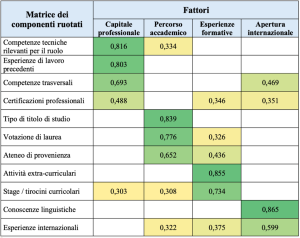
Figure 2: Matrix of components rotated using Varimax rotation
To better understand these patterns, a Factor analysis was first conducted, reducing the different CV attributes into four underlying factors:
- Professional capital (work experience, technical and soft skills)
- Academic background (degree, university, grades)
- Educational experiences (internships, extracurricular activities)
- International openness (languages and international exposure)
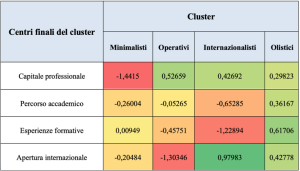
Figure 3: Table of Final Destinations
Building on these results, a Cluster analysis identified four distinct recruiter profiles, each characterized by a different evaluation logic:
- Minimalists à low importance assigned to all attributes
- Operational-oriented à strong focus on experience and skills
- Internationalists à emphasis on global exposure and international openness
- Holistic evaluators à balanced assessment across all dimensions
This segmentation shows that the value of a PhD is not universal, but depends on the underlying decision logic of the recruiter.
The role of a PhD: positive, but not decisive
The Conjoint analysis reveals a key insight. Respondents were asked to evaluate eight different candidate profiles, each representing a combination of attributes typically found in a CV for a generic position.
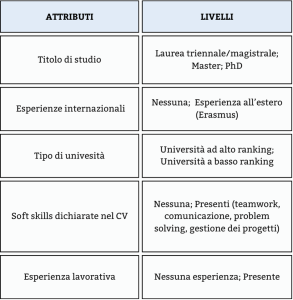
Figure 4: Profile Attributes and Levels
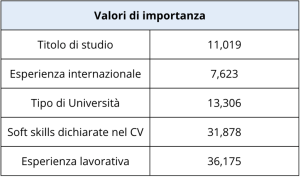
Figure 5: Important Values
A PhD accounts for approximately 11% of the overall decision weight. In other words:
- it is generally preferred over other academic qualifications
- but it carries limited influence compared to experience and soft skills
Most importantly, the value of a PhD is not standalone: it increases when combined with relevant experience and transferable skills, and decreases when considered in isolation.
To better understand how attributes interact, three simulation scenarios were developed, testing whether weaknesses in one area can be compensated by strengths in others.
Three key profiles were compared:
- a candidate with a PhD but no work experience
- a candidate with work experience but no academic pedigree
- a candidate with a PhD but non soft skills
The preferred profile is the one with work experience, even in the absence of a strong academic background. This result reinforces a clear message: practical experience and transferable skills can outweigh academic excellence, highlighting how the value of a PhD depends on the overall profile rather than the title alone.
Italy vs. UK: more similar than expected
Contrary to common assumptions, the overall evaluation structure is quite similar between Italy and the UK.
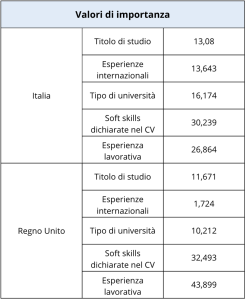
Figure 6: Comparison of Importance Scores by Country
Across both contexts, academic qualifications play a relatively limited role in the overall decision-making process, accounting for roughly 10-11% of the final evaluation weight. The differences lie more in emphasis than in structure:
- Italy à slightly higher importance assigned to academic signals (degree, university background)
- UK à stronger focus on work experience, which emerges as the dominant driver
In terms of preferences, the Conjoint results also reveal a subtle distinction:
- in Italy, the PhD is the most preferred academic qualification
- in the UK, the Master’s degree tends to be favored
Simulation results further support this pattern: in Italy, the preferred profile tends to reflect stronger academic signals, whereas in the UK candidates with work experience are more likely to be selected, even in the absence of a strong academic background.
However, these differences do not fundamentally change the overall picture.
In both countries, academic titles, while positively perceived, remain secondary drivers compared to practical experience and transferable skills.
This suggests that the value of a PhD is not significantly shaped by national context, but rather by broader evaluation logics that are consistent across labor markets.
Managerial implications: how to enhance the value of a PhD
The findings highlight a set of actionable insights for both candidates and organizations aiming to better leverage the value of a PhD in the job market.
- Translate the PhD into skills
A degree alone is not enough. Candidates need to clearly communicate the competencies developed during their PhD, such as analytical thinking, problem-solving, and autonomy, in a way that resonates with business needs.
- Integrate practical experience
Internships, industry collaborations, and applied projects significantly increase the perceived value of a PhD by reducing the gap between academic training and real-world applications.
- Structure HR policies
Many companies still lack clear frameworks for evaluating PhD candidates. Defining structured guidelines and consistent evaluation criteria can improve both fairness and effectiveness in recruitment.
- Strengthen university-industry collaboration
Industrial PhDs and joint initiatives between academia and companies represent a key lever to align skills with market needs and facilitate knowledge transfer.
Conclusions
A PhD is not ignored in the job market, but its value is often latent and underleveraged. It creates real value when it is:
- translated into relevant and understandable skills
- combined with practical, real-world experience
- recognized within structured and coherent HR processes
Ultimately, in an increasingly skills-driven job market, the future of the PhD will depend not only on its academic rigor, but on its ability to connect with industry needs and organizational practices.


 LinkedIn:
  Instagram: