

The Evolution of Customer Experience in the Beauty Sector: The Sephora Case Between Digital Innovation and Customer Loyalty

Author: Gloria Maria Musarò
Date: 06-11-2026
Customer Experience in the beauty sector has evolved into a hybrid architecture where physical stores, digital platforms, reviews, and personalized tools coexist. The journey is no longer linear; it is dynamic, omnichannel, and shaped by multiple layers of interaction.
The global beauty & personal care market reached $441 billion in 2024, confirming its resilience and structural growth. Yet beyond the numbers, the real transformation concerns how value is constructed. Consumers no longer evaluate isolated products, but interconnected systems of touchpoints that together shape perception, trust, and preference.
In this context, a key question emerges:
How do consumers build their beauty purchasing experience, and which drivers truly shape their decisions?
The research adopted a quantitative approach supported by desk research to analyze how Customer Experience is structured in the beauty sector and how digital and physical touchpoints influence purchasing behavior, with a specific focus on Sephora.
The objective was to identify the main decision drivers and understand how functional, relational, and aesthetic components contribute to perceived value and engagement.
The sample
The online questionnaire collected 201 valid responses, after data cleaning and screening procedures. The sample is predominantly female (around 90%), reflecting the structural composition of the beauty market, while also including a smaller but growing male component.
From an age perspective, respondents are distributed across different life stages, with a stronger presence of individuals between 41 and 60 years old, followed by the 26–40 and 18–25 segments. This heterogeneity allows for the observation of generational differences in purchasing behavior and sensitivity to digital tools.
Beauty consumption emerges as a habitual practice: more than half of respondents purchase products once or twice a month, confirming the routine-based nature of the category. The majority adopt an omnichannel approach, alternating between online platforms and physical stores depending on product type and purchase objectives.
Motivations are primarily linked to self-care and personal well-being rather than purely aesthetic enhancement, highlighting the increasingly holistic meaning attributed to beauty consumption.
When evaluating decision drivers, respondents demonstrate a structured and rational approach. Price and product quality dominate, while experiential elements such as packaging or in-store atmosphere play a complementary role. Openness toward AI-based tools remains moderate: although many have not yet used them, there is curiosity toward practical functionalities such as personalized promotions and tailored recommendations.
To better understand purchasing logic, a cluster analysis segmented consumers into three distinct profiles, each characterized by a different balance between functional, relational, and aesthetic drivers.
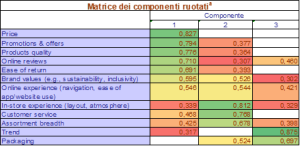
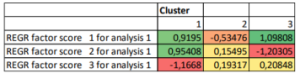
- Value Balancers: This segment integrates economic and relational dimensions. Price and product quality are essential, but service quality, assortment, and in-store experience also contribute to the final evaluation. Their approach is balanced: functional value is necessary, but experience reinforces trust and satisfaction.
- Moderate Aesthetes: These consumers show lower overall involvement but display relative sensitivity toward aesthetic and symbolic aspects such as packaging and brand image. Their decision process is more flexible and less polarized, making them a transversal and less rigid segment.
- Value Pragmatists: This cluster is strongly price-oriented. Discounts, quality-to-cost ratio, and economic convenience represent the main decision levers. Experiential and aesthetic components play a marginal role.
The Structure of Preference
While cluster analysis explains who the consumers are, conjoint analysis clarifies how value is constructed.
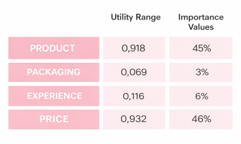
The results show a clear hierarchy: price and product type dominate preference formation, confirming that economic convenience and performance represent the structural core of choice. Utility decreases as price increases, highlighting transversal sensitivity to cost. Packaging and purchase experience, although positively evaluated, exert a significantly lower impact on overall preference.
Generational differences reinforce this pattern. Younger consumers show stronger price sensitivity, middle segments adopt a more balanced approach, and mature consumers prioritize product performance. Across life stages, functional value remains the anchor.
Sephora: Core Drivers and Future Opportunities
Within this structured value architecture, Sephora represents a relevant case study. The brand benefits from strong brand awareness and a solid functional positioning. The main drivers of satisfaction are structural and reliability-oriented: payment security, breadth of assortment, and continuous product innovation. These elements reinforce trust and are particularly aligned with consumers who prioritize price–quality balance and product performance. However, experiential dimensions such as customer service, promotional intensity, and in-store engagement receive comparatively lower evaluations, highlighting a clear area for strategic development.
In terms of future opportunities, AI emerges as a promising but selective lever. Consumers show interest in practical functionalities, especially personalized promotional alerts and tailored product recommendations, while immersive or purely experiential technologies appear less decisive. For Sephora, the opportunity lies in strengthening data-driven personalization, optimizing promotional strategies based on repurchase cycles, and ensuring seamless integration between in-store interactions and digital profiles. The strategic challenge is not adding more technology, but aligning innovation with the functional value architecture that already anchors consumer choice.
Conclusions
The research consistently highlights a structural pattern: beauty consumption is emotionally framed, yet rationally executed. Price and product performance remain the primary anchors of choice, while Customer Experience strengthens differentiation only when the functional foundation is solid. For brands like Sephora, long-term competitive advantage lies in orchestration, aligning economic value, product excellence, omnichannel coherence, and data-driven personalization within a unified strategic architecture. Experience does not replace value; it amplifies it.



 LinkedIn:
 Instagram: