

Premium Food & Beverage Consumption in India: What Consumers Value in 2026

Author: Hannah Silberstein
Date: 12-11-2026
India’s food and beverage landscape is becoming increasingly diverse. Consumers now encounter international cuisines, imported ingredients, premium grocery products, and new dining concepts through restaurants, delivery platforms, supermarkets, and social media. However, greater exposure does not automatically mean that consumers will choose a product simply because it is foreign or positioned as premium.
To better understand these changing preferences, Analytics Arts conducted a 2026 consumer survey examining how Indian consumers discover and select food and beverage options, their interest in premium and international products, their expectations of authenticity, and their attitudes toward categories such as European wine and Extra Virgin Olive Oil (EVOO).
The results point to a market that is curious but selective. Consumers are open to premium experiences, but their decisions remain grounded in practical priorities such as hygiene, taste, value, accessibility, and quality. They also want international products to feel authentic, while still fitting comfortably into local tastes and everyday habits.
Premium Does Not Simply Mean Imported
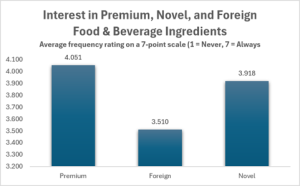
When purchasing groceries for cooking at home, respondents reported looking for premium ingredients more frequently than they looked specifically for foreign ingredients. On the survey’s seven-point frequency scale, premium ingredients received an average score of 4.05, followed by novel ingredients at 3.92. Foreign ingredients received the lowest average of the three, at 3.51.
These scores indicate moderate rather than universal interest, but the ranking is meaningful. Consumers appear to distinguish between something being premium and something merely being imported. A foreign origin can create interest, but it may not be enough to establish value on its own.
For brands, this means that country of origin should support a product’s positioning rather than replace its value proposition. Imported products still need to explain why they are superior or relevant. That may involve ingredient quality, distinctive taste, craftsmanship, nutritional benefits, convenience, or a stronger overall experience.
This distinction is particularly important as international products become more widely available. As access increases, imported status may feel less exclusive. Brands may therefore need to move beyond novelty and communicate the practical and emotional benefits that make a product worth choosing repeatedly.
Trust, Taste, and Value Drive Food Choices
Premium positioning may attract attention, but the survey suggests that practical product and experience attributes ultimately drive consumer decisions.
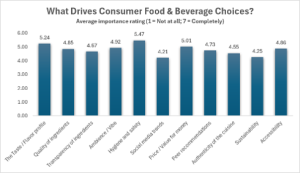
Among the factors influencing the discovery and selection of new food and beverage options, hygiene and safety ranked highest, with an average score of 5.47 out of 7. Taste and flavor followed at 5.24, while price and value for money scored 5.01.
Several other factors also received relatively strong ratings. Ambience and vibe averaged 4.92, accessibility averaged 4.86, and quality of ingredients averaged 4.85. Transparency of ingredients and peer recommendations were also influential, with averages of 4.67 and 4.73, respectively.
By comparison, sustainability averaged 4.25, while social-media trends received the lowest average rating at 4.21. These factors still mattered, but they were less influential than direct and tangible considerations such as safety, taste, and value.
The results show that premium consumption is not only about indulgence, aesthetics, or status. Consumers want experiences that are enjoyable, but they also want reassurance. A premium restaurant with attractive branding may struggle if consumers question its hygiene. A beautifully packaged imported product may fail if shoppers cannot understand its quality or justify its price.
Social media can still help consumers discover products and places, but its lower rating suggests that online visibility does not replace the fundamentals. Brands may be able to generate initial attention through trends and influencers, but long-term preference is more likely to come from delivering a strong product experience.
Imported Products Are Accessible, but There Is Still Room to Improve
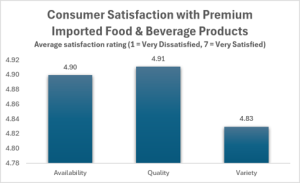
Respondents were generally positive about the current market for premium imported food and beverage products. Satisfaction with their quality averaged 4.91 out of 7, while availability averaged 4.90 and variety averaged 4.83.
These scores sit above the neutral midpoint of four, indicating that consumers are more satisfied than dissatisfied. However, the results are not overwhelmingly positive. A meaningful share of respondents selected neutral or only somewhat satisfied responses, suggesting that availability and variety can still improve.
A separate question asked whether consumers found it easy to purchase authentic, premium foreign ingredients for home consumption. The average agreement score was 4.57 out of 7. Again, this is positive, but not exceptionally strong.
The findings suggest that imported products are no longer viewed as entirely inaccessible, yet the consumer experience may still be inconsistent. Availability can vary between cities, retailers, online platforms, and product categories. Even when products are available, consumers may face limited choices, unclear information, or prices that make regular purchasing difficult.
For premium international brands, distribution is therefore part of the brand experience. Marketing can generate demand, but consumers must also be able to find the product easily and understand how to use it. Reliable retail availability, clear product information, and accessible online purchasing may be just as important as the brand story itself.
Authenticity Matters Most When It Remains Approachable
International cuisine presents brands and restaurants with a familiar challenge: should they preserve a traditional recipe exactly, or adapt it to local tastes?
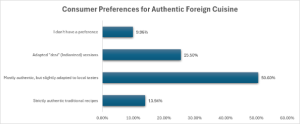
The 2026 findings suggest that most consumers prefer a middle ground. Just over half of respondents, 50.6%, selected food that is mostly authentic but slightly adapted to local preferences. A further 25.5% preferred clearly adapted “desi” versions, while 13.9% preferred strictly authentic traditional recipes. The remaining 10.0% had no preference.
This means that nearly two-thirds of respondents selected either strictly authentic food or food that remained mostly authentic. Authenticity therefore retains strong appeal. However, the largest group did not demand complete adherence to tradition; they preferred a version that preserves the cuisine’s identity while making limited adjustments for local tastes.
Among those preferring authentic or mostly authentic versions, 78.4% said they wanted to experience the true culture of the country. Another 38.9% associated authentic ingredients with higher quality. These responses show that authenticity is not only about flavor. It can communicate cultural experience, credibility, and craftsmanship.
Consumers preferring adapted desi versions offered more practical reasons. 51.6% preferred spicier or bolder flavors, 46.9% found adapted dishes more comforting and familiar, and 35.9% said adapted versions usually offered better vegetarian options.
The opportunity for international brands is therefore not to choose between authenticity and localization as complete opposites. The strongest approach may be to protect the core identity of the product while adapting carefully. That might mean adjusting spice, introducing vegetarian alternatives, using familiar formats, or offering serving suggestions that make an international product easier to incorporate into local routines.
European Wine Has Premium Appeal, but Knowledge Remains Uneven
The survey’s wine section was shown to a smaller and more specific group. Among the respondents who consumed alcohol, wine represented one of several commonly consumed categories. However, only 52 respondents completed the detailed wine-attitude questions, so these results should be interpreted as directional rather than representative of the entire sample.
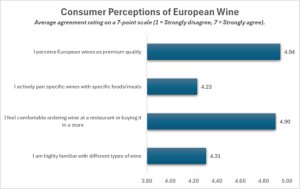
Within this group, European wines were clearly associated with premium quality. Agreement with the statement that European wines, such as Italian, French, and German wines, are premium averaged 4.94 out of 7.
Respondents also reported a relatively high level of comfort when purchasing or ordering wine, with an average of 4.90. However, their familiarity with grape varieties and wine regions was lower, averaging 4.31. Their agreement that they actively paired specific wines with foods was similarly moderate, at 4.23.
This creates an interesting gap: consumers may feel comfortable buying wine and may already associate Europe with quality, even when their technical knowledge remains limited. For brands, this suggests that the category does not need to begin by convincing consumers that European wine is premium. Instead, the opportunity may lie in making the category easier to understand.
Clear descriptions, simple food-pairing guidance, approachable tasting notes, and education on regions or grape varieties could help convert premium perceptions into more confident and frequent purchasing.
The tariff question provides additional context. 40.4% said reduced import tariffs would not alter their purchasing habits. However, 26.9% said they would purchase imported European wine much more frequently, while another 25.0% expected to purchase it slightly more frequently. Combined, just over half indicated some potential increase.
This does not guarantee immediate growth, but it suggests that price and accessibility could encourage existing interest, particularly when supported by education and strong retail availability.
EVOO Awareness Is Broad, but Understanding Is Not Yet Complete
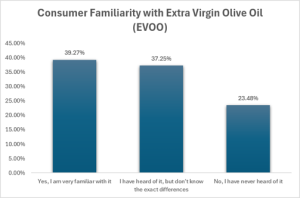
Extra Virgin Olive Oil presents a different premium opportunity. Awareness is already relatively widespread: 39.3% of respondents said they were very familiar with EVOO, while 37.2% had heard of it but did not know exactly how it differed from regular cooking oils. A further 23.5% had never heard of it.
This means that more than three-quarters of respondents recognized the term, but only around four in ten considered themselves very familiar. The challenge is therefore not simply building awareness. It is helping consumers understand what EVOO is, why it differs from other oils, and how it can be used.
Among respondents answering the health-benefit question, 59.9% associated EVOO with heart health or cholesterol benefits. Approximately 46.0% associated it with skin and hair benefits, while 45.5% connected it with antioxidants. Weight management and anti-inflammatory properties were also selected by more than one-third.
Usage intentions were led by light sautéing or pan-frying at 46.5%, closely followed by raw dressings for salads or breads at 45.9%. Smaller groups selected skin or hair care, baking, or deep frying. Around 20.5% said they did not use and did not intend to use EVOO.
These results suggest that health messaging can attract attention, but it should be paired with practical instruction. Consumers may know that EVOO is considered healthy without knowing when to use it, how much to use, or why its price differs from standard cooking oils.
For brands, the strongest education may be specific rather than general: how EVOO works in light Indian cooking, how it can be used as a finishing oil, what flavor it adds, and how to choose between product types. Connecting health benefits to realistic use cases may make EVOO feel less like a specialist foreign ingredient and more like a useful premium product for everyday life.
A More Critical View of the Food and Beverage Industry
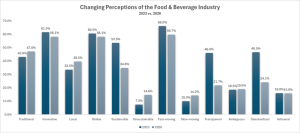
The survey also asked respondents how they currently perceive the wider food and beverage industry. The most frequently selected description was fast-moving, chosen by 59.7%, followed closely by innovative and global, both at 58.1%.
However, fewer respondents described the industry as sustainable or transparent. Sustainability was selected by 34.8%, while transparency was selected by only 21.7%.
This is one of the clearest areas for comparison with the 2023 India benchmark because both studies used the same broad industry-perception format. In 2023, 53.5% described the industry as sustainable and 46.0% described it as transparent. The corresponding 2026 figures are notably lower.
Innovation and speed remained more stable. In 2023, 61.5% selected innovative and 66.0% selected fast-moving, compared with 58.1% and 59.7% respectively in 2026.
The comparison should not automatically be interpreted as proof that the industry has objectively become less sustainable or transparent. It may instead indicate higher consumer expectations, greater skepticism, or increased attention to how brands support their claims.
For companies, the implication is clear: broad statements may no longer be enough. Consumers may expect specific evidence about sourcing, packaging, ingredient information, supply chains, and production methods. Brands that communicate these details clearly may be better positioned to build trust.
What This Means for Premium Food and Beverage Brands
The 2026 findings show that premium consumers are open to new ideas, but they are not easily won by premium language alone.
First, premium value needs to be demonstrated. Products should explain what makes them better, whether through ingredients, taste, health benefits, production, or the overall experience.
Second, the basics remain essential. Hygiene, flavor, value, quality, and accessibility rank above more fashionable influences such as social-media trends. Brands need to perform well at the fundamentals before relying on lifestyle positioning.
Third, authenticity works best when it remains approachable. Consumers want international food to retain cultural identity, but many also appreciate thoughtful adaptation to local flavors, dietary needs, and habits.
Finally, emerging categories require education. European wine already carries premium associations, but knowledge remains uneven. EVOO has broad awareness, but many consumers do not fully understand its differences or uses. In both cases, simple and practical guidance may help convert curiosity into purchasing.
Conclusion
India’s premium food and beverage market is not defined by a simple desire for foreign products. Consumers are exploring international cuisines and ingredients, but their decisions remain selective and grounded in trust, taste, value, quality, and accessibility.
The strongest opportunities may belong to brands that combine global credibility with local relevance. Premium products should feel distinctive without feeling confusing, authentic without feeling inaccessible, and aspirational without losing practical value.
As consumers become more informed, they may also become more demanding. Brands will need to support claims around quality, sustainability, and transparency with evidence, while helping consumers understand how premium products fit into everyday life.
The market is open to new experiences, but success will depend on offering more than novelty. It will depend on delivering products and experiences that consumers can trust, understand, enjoy, and return to.



 LinkedIn:
 Instagram: