

Quiet Luxury and Bottega Veneta: When Luxury Becomes Recognizable Without Showing Itself

Author: Lea Radaelli
Date: 28-08-2026
Can a luxury brand be recognized without seeing its logo?
In recent years, this question has become increasingly relevant for understanding the new dynamics that characterize the evolution of the luxury market. In a context where consumers are becoming more informed, selective, and conscious, the value of a product is no longer measured solely through its ability to communicate status in an immediate and visible way. On the contrary, a growing segment of consumers appears to be moving toward more discreet, refined, and less ostentatious forms of distinction.
It is within this context that the phenomenon of Quiet Luxury emerges, a form of luxury that prioritizes quality, craftsmanship, durability, aesthetic consistency, and more subtle symbolic codes. Luxury does not disappear; rather, it changes its language: it no longer necessarily speaks through prominent logos or immediately recognizable symbols, but through details, materials, craftsmanship, and forms that can be understood primarily by a culturally knowledgeable audience.
This research analyzes this shift through the case of Bottega Veneta in the luxury handbag market. The brand represents a particularly interesting case because it has historically built its identity around the absence of a visible logo, the valorization of artisanal savoir-faire, and the Intrecciato weave, which has become one of the maison’s most distinctive codes over time.
The Luxury Market and the Rise of Quiet Luxury
Although the luxury market continues to grow, what is changing above all is the way consumers interpret value. Today, luxury products are no longer perceived exclusively as status symbols, but increasingly as tools for personal and identity expression. From this perspective, Quiet Luxury does not eliminate branding; it transforms it: the brand is no longer necessarily communicated through a visible logo, but through a set of aesthetic, material, and symbolic signals that allow the product to be recognized without being ostentatious.
The Bottega Veneta Case
Bottega Veneta has built its positioning around an idea of discreet luxury since its origins, summarized by the famous motto, “When your own initials are enough.” Unlike many other brands in the sector, the maison has not built its recognizability through a visible logo, but through more implicit codes, such as the Intrecciato weave, the quality of its leather, and a precise aesthetic consistency. For this reason, the Bottega Veneta case makes it possible to observe a central tension within Quiet Luxury: can a code that was born as discreet truly remain silent when it becomes highly recognizable?
Research Objectives and Methodology
The research aims to analyze the phenomenon of Quiet Luxury in the luxury handbag market, exploring both consumer perceptions and the strategic implications for a brand that has built its identity on the balance between discretion and recognizability.
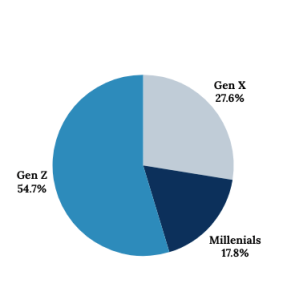
The study was conducted through a mixed-method approach. An initial qualitative phase involved seven female consumers and one industry expert, while the quantitative phase was based on an online questionnaire that collected 214 valid responses. In particular, the final sample consisted predominantly of women, who represented 96.3% of respondents. From a generational perspective, Generation Z accounted for 54.7% of the sample, followed by Generation X with 27.6% and Millennials with 17.8%.
The Drivers of Luxury Handbag Purchases
The first part of the quantitative analysis investigated which factors most strongly influence the choice of a luxury handbag. Respondents were asked to evaluate several aspects on a scale from 1 to 7, where 1 corresponded to “not important” and 7 to “very important.”
The results show that the main purchase drivers are durability over time (5.99), aesthetic design (5.88), and material quality (5.88). Conversely, the least relevant elements are logo visibility (2.32), model popularity (2.96), and current trends (3.08).
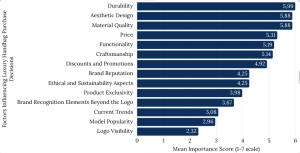
These findings suggest that the choice of a luxury handbag is not driven exclusively by the desire to display an obvious status symbol, but also by the search for quality, aesthetic consistency, and lasting value. The analysis also identified three main consumer profiles:
- Pragmatic consumers (35.5%), primarily oriented toward functionality and value for money;
- Aesthetic consumers (35.5%), mainly guided by the product’s design and visual coherence;
- Fashion-oriented consumers (29%), more sensitive to recognizability, trends, and model popularity.
The presence of these segments highlights how the perception of value in luxury is multidimensional. Recognizability remains a relevant factor, but it is neither the only one nor necessarily the most important. For a significant portion of consumers, the value of a luxury handbag lies in its ability to combine quality, aesthetics, and identity in a coherent way.
The Perception of Quiet Luxury
One of the most interesting findings concerns awareness of the concept of Quiet Luxury. Although only 39.7% of respondents initially stated that they were familiar with it, once the meaning of the term was explained, many consumers identified with the values it represents.
Participants showed a high level of agreement with the idea that Quiet Luxury is a form of luxury that does not require prominent logos and that communicates elegance without attracting excessive attention. Conversely, the idea that discreet luxury is less prestigious or incapable of conveying status received little support.
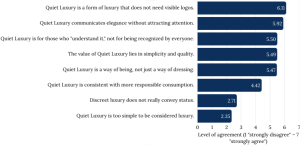
These findings suggest that discretion is not perceived as an absence of value, but as a different way of constructing status: less immediate, less ostentatious, and more culturally coded.
Bottega Veneta and the Codes of Implicit Recognizability
Turning to the case of Bottega Veneta, the research analyzed which elements are spontaneously associated with the brand. The most frequently cited code is the Intrecciato weave, mentioned by 38% of respondents, followed by high-quality leather, cited by 22%, and the brand’s color palette, indicated by 14%.
These findings confirm that the brand’s recognizability does not depend on a traditional graphic symbol, but rather on a set of aesthetic and material codes that allow consumers to identify the product even in the absence of a visible logo.
However, the analysis also highlights a more nuanced result. Bottega Veneta is perceived as close to Quiet Luxury, but not necessarily as a fully “silent” expression of it. This is because some codes that originated as discreet, particularly the Intrecciato weave, have now become widely recognizable.
Conjoint Analysis: The Role of the Logo and the Intrecciato Weave
To better understand the role of different elements in influencing purchase intention, a conjoint analysis was conducted on the Mini Jodie model by Bottega Veneta. The analysis considered the impact of four main attributes: the presence or absence of the Intrecciato weave, the presence or absence of a logo, product availability, and price.
The results show that the logo is the element with the greatest impact on purchase intention, but it presents a negative utility value, meaning that its absence increases purchase intention.
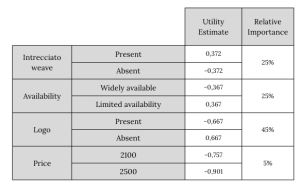
In particular, holding price and market availability constant, the configuration preferred by consumers is the one characterized by the presence of the Intrecciato weave and the absence of a logo.
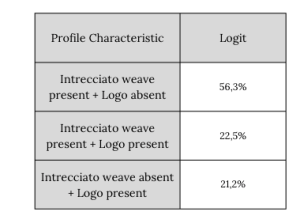
This finding confirms that consumers do not reject branding itself; rather, they prefer brand identity to be communicated through codes embedded within the product rather than through explicit and ostentatious signs.
The Risk of Symbolic Inflation
One of the most interesting aspects emerging from the research concerns the concept of symbolic inflation. In the context of Quiet Luxury, a discreet code works because it is recognizable to a knowledgeable niche, but not necessarily to everyone. Its strength lies in the balance between visibility and discretion.
However, when that code becomes highly widespread, desirable, and easily identifiable, it risks losing its silent nature. For Bottega Veneta, this issue is particularly relevant: the Intrecciato weave remains a fundamental brand asset, but its growing popularity makes it necessary to complement it with additional identity signals in order to preserve the brand’s ability to communicate exclusivity, discretion, and sophistication.
Conclusions
Quiet Luxury represents a profound transformation in the way luxury is constructed, communicated, and perceived. It is not a form of luxury devoid of identity, nor is it an invisible luxury. On the contrary, it is a form of luxury in which brand identity is communicated through subtler, less explicit, and more culturally coded signals.
The Bottega Veneta case demonstrates that recognizability can exist even without a logo, through aesthetic, material, and artisanal codes. However, the growing diffusion of these codes poses a new challenge: maintaining the balance between recognizability and discretion.
The research therefore confirms the existence of a demand for implicit recognizability and introduces the concept of symbolic inflation of discreet codes, highlighting how even the most subtle signals can become, over time, forms of explicit recognizability.
In summary, Quiet Luxury is not the absence of communication. It is a quieter, more selective, and more sophisticated form of communication. And precisely for this reason, perhaps, an even more powerful one.


 LinkedIn:
  Instagram: