

From Screen to the Dolomites: How Much Do TV Series Really Influence Travel Decisions?

Author: Margherita Silva
Date: 19-11-2026
The main goal of this research is to understand and analyze the impact of television storytelling on travel decisions, focusing on the Dolomites region through the series “Un passo dal cielo”. Based on this premise, five specific research questions were formulated to understand and segment the mountain tourism market, identify the primary factors influencing mountain destinations, and investigate whether, and to what extent, television can guide the choice of a tourist destination.
The empirical investigation was conducted by administering questionnaires via Qualtrics, followed by data processing using SPSS software to derive rigorous statistical insights. This fieldwork is grounded in an in-depth theoretical study of “film-induced tourism” (or “set-jetting”), the phenomenon that draws travelers to locations seen on screen. From a niche sector in the 1950s, it has now reached mass dimensions: an evolution that, on the one hand, generates significant opportunities for territorial and economic development, but on the other, exposes destinations to concrete risks such as overtourism, the commodification of the territory, and the subsequent loss of authenticity.
Prior to the fieldwork, historical data on tourist flows (2006-2025) were analyzed to assess the objective impact of the series. In Val Pusteria, the setting for the first five seasons, strong growth has been recorded since 2014, with arrivals exceeding 1,150,000.
In the Venetian Dolomites, the location from the sixth season onwards, the arrival of the TV drama halted a fifteen-year tourism decline, stabilizing visitor numbers. However, the data reveal a significant structural limitation: film-induced tourism amplified overall volumes but did not foster deseasonalization; flows therefore remain heavily concentrated during peak seasons, fueling the risk of overtourism without ensuring a sustainable balance for the territory.
The survey is based on a non-probability sample of 231 tourists, directly involving the Italian Alpine Club (CAI) to intercept true mountain enthusiasts. The panel, with a slight female majority (54.5%) and concentrated mainly in the North-West (70.1%), includes 204 travelers who have already explored the Dolomites and 110 viewers of the series. During their holidays, activities are primarily divided between trekking (73%), relaxation (49%), and winter sports (49%). At the decision-making level, while the inspiration for a destination stems primarily from word-of-mouth (69%) and social media (38%), with a solid 23% influenced precisely by audiovisuals, the main factors deterring departure remain excessive crowding (67%) and high prices (60%).
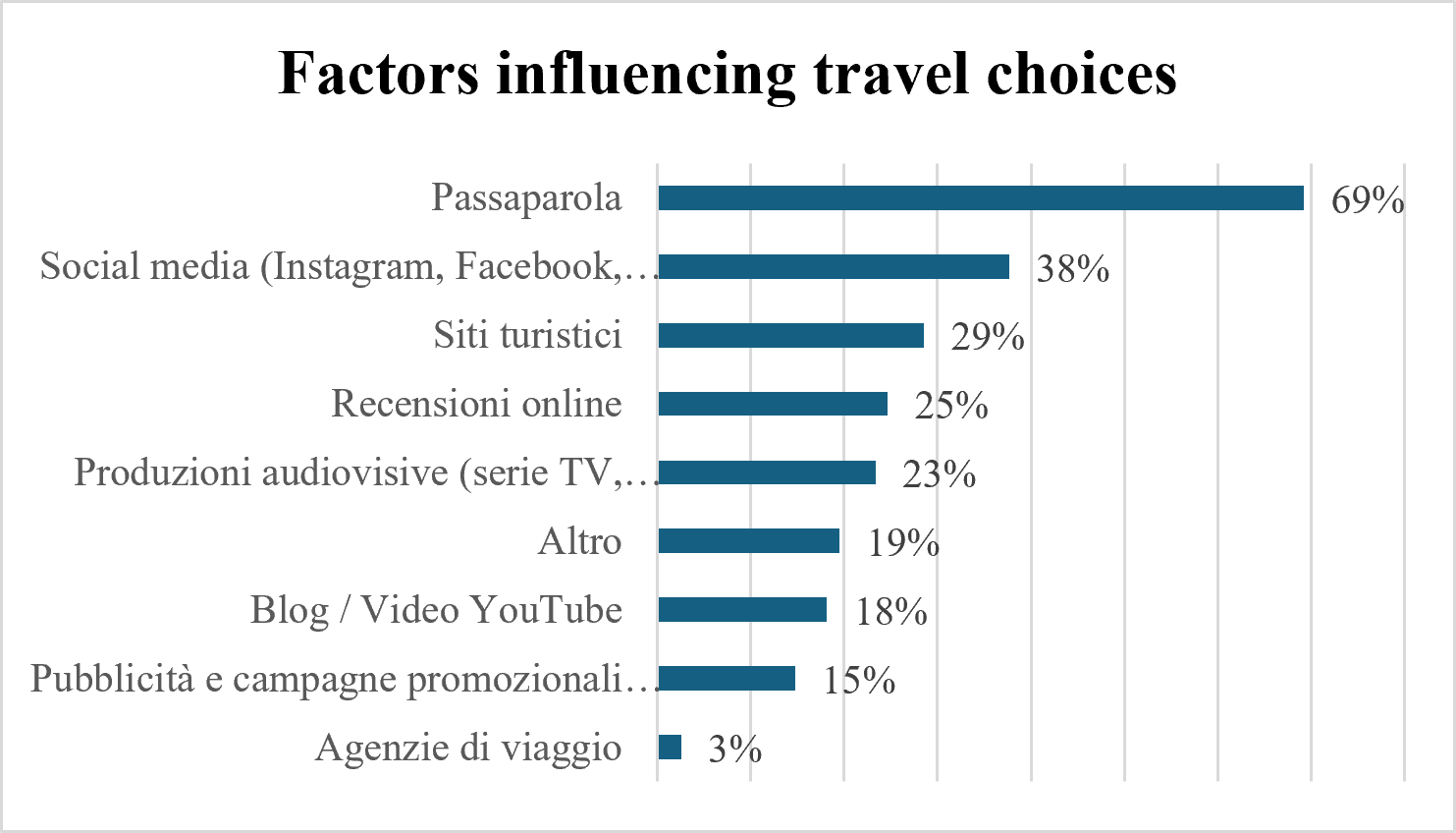
Distribution of information channels and media sources influencing travel choices
(Source: author’s own elaboration using SPSS/Excel based on questionnaire data)
Using factor analysis, 10 items were extracted and divided by travel motivations, attributes sought in the mountain destination, and general perceptions of audiovisual productions as sources of inspiration.
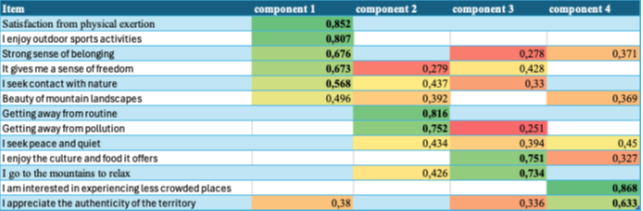
Rotated Component Matrix (Varimax method) for travel motivation items
(Source: author’s own elaboration using SPSS/Excel based on questionnaire data)
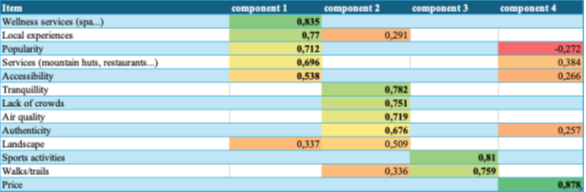
Rotated Component Matrix (Varimax method) on the attributes influencing the attraction to and choice of mountain destinations (Source: author’s own elaboration using SPSS/Excel based on questionnaire data)
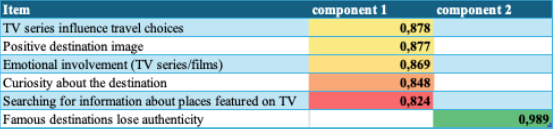
Rotated Component Matrix (Varimax method) on the impact of audiovisual productions and the set-jetting phenomenon (Source: author’s own elaboration using SPSS/Excel based on questionnaire data)
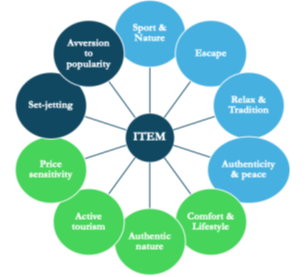
Representation of the 10 key factors extracted from the factor analysis regarding mountain tourist motivations and preferences (Source: author’s own elaboration using SPSS/Excel based on questionnaire data)
These allowed for a subsequent cluster analysis, through which the perceptual and motivational dimensions of the travelers were explored. This procedure identified four distinct segments of mountain tourists: the Authenticity Seekers (24.2%) are the mountain purists: they shun mass tourism and media influence to immerse themselves exclusively in nature and silence. The Disinterested Tourists (15.6%), mostly young students, travel for leisure with friends but are heavily deterred by high prices and totally indifferent to the appeal of the TV series. The Active Mountaineers (44.6%), the largest group, experience the territory in a dynamic and sporty way, seeking spectacular landscapes and safe trails; they recognize the promotional power of TV without basing their choices on it. Finally, the Wellness Set-Jetters (15.6%) embody the ideal target for “set-jetting”: they choose the destination specifically to relive the atmosphere of the TV series, combining the trip with the search for premium services and total relaxation.
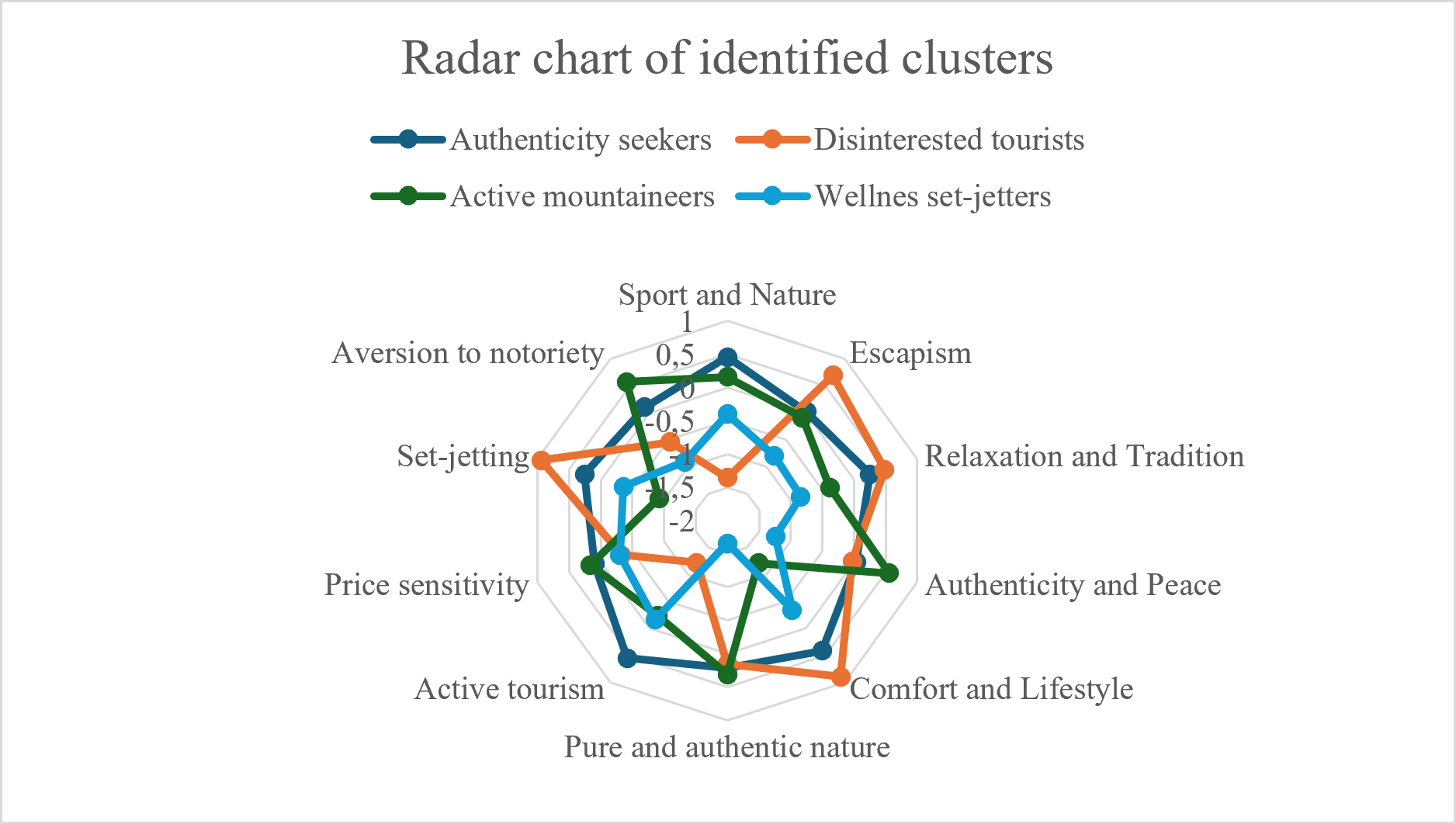
Radar chart summarizing the positioning of the four clusters in relation to the extracted motivational and decision-making factors (Source: author’s own elaboration using SPSS/Excel based on questionnaire data)
The central question, however, remained: is film-induced tourism truly a primary decision-making lever? To answer this, a conjoint analysis was applied. The results unequivocally demonstrated that the decision-making pillars remain structural attributes. The beauty of the landscape confirms itself as the absolute driver (32.65%), followed by the importance attributed to price (25.70%) and the desire for low crowding (22.08%). The appeal of the film set, conversely, accounts for only 19.56%. Although the television series “Un passo dal cielo” generated cross-cutting awareness for the destination, television storytelling is thus confirmed as an important promotional lever, but not an independent driver of tourism choice.
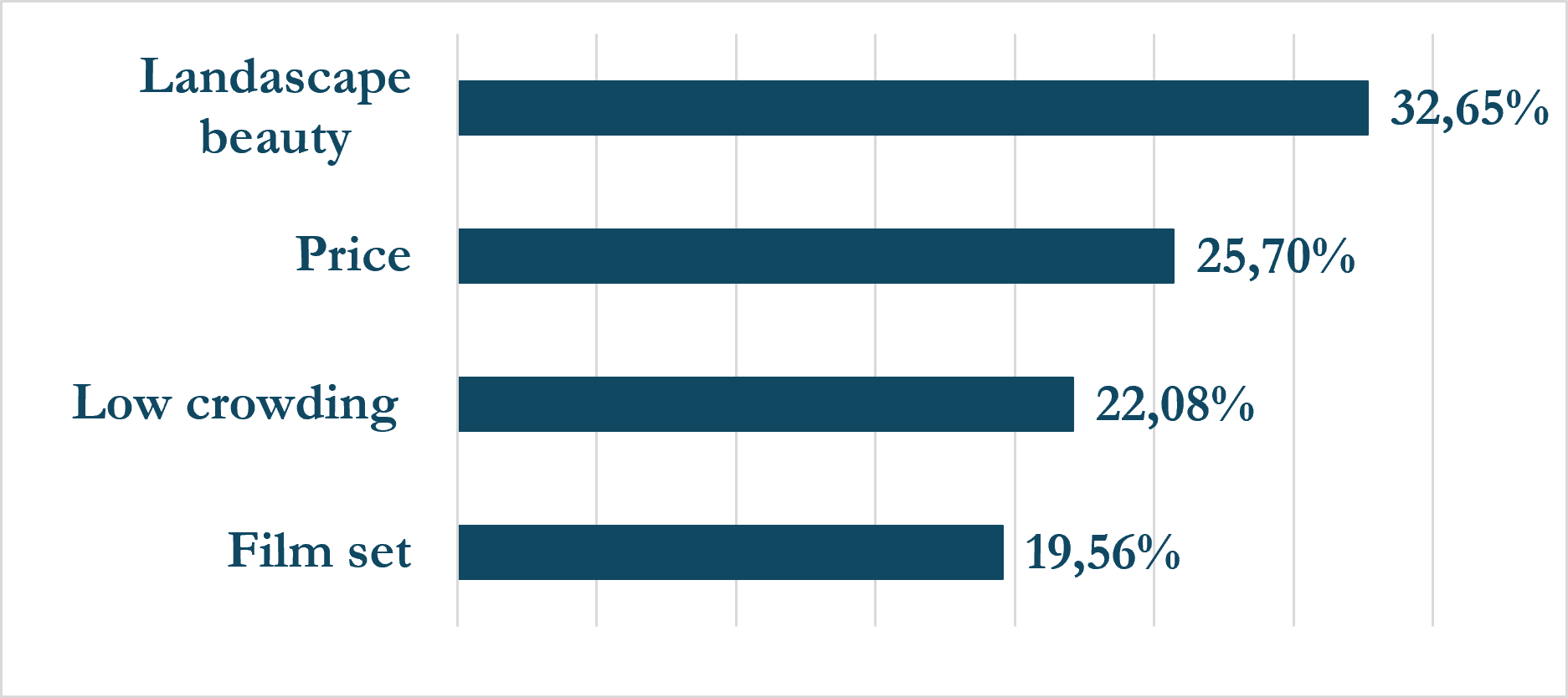
Relative importance of attributes in the choice of a mountain destination, obtained through conjoint analysis (Source: author’s own elaboration using SPSS/Excel based on questionnaire data)
In conclusion, Destination Management Organizations (DMOs) are called upon to face a complex challenge. For media potential to translate into a real competitive advantage, it is necessary to move beyond the logic of pure promotion and adopt a management approach based on data-driven activities, fostered by solid territorial synergies. Furthermore, the implementation of “phygital” destination management, supported by invisible demarketing strategies, is essential for guiding visitors, curbing overcrowding, and preserving the balance of the destination.
Ultimately, the real challenge is not to turn off the spotlight on these mountains, but to learn how to direct its light. Only by transforming the allure of the screen into a real, conscious experience that respects the carrying capacity of the territory will the Dolomites continue to be a masterpiece not just to look at, but to live in over time.



 LinkedIn:
 Instagram: